 4d4d8089c7
|
||
|---|---|---|
| attacks | ||
| classification_models | ||
| evaluations | ||
| inversion_methods | ||
| resources | ||
| README.md | ||
README.md
Latent HSJA

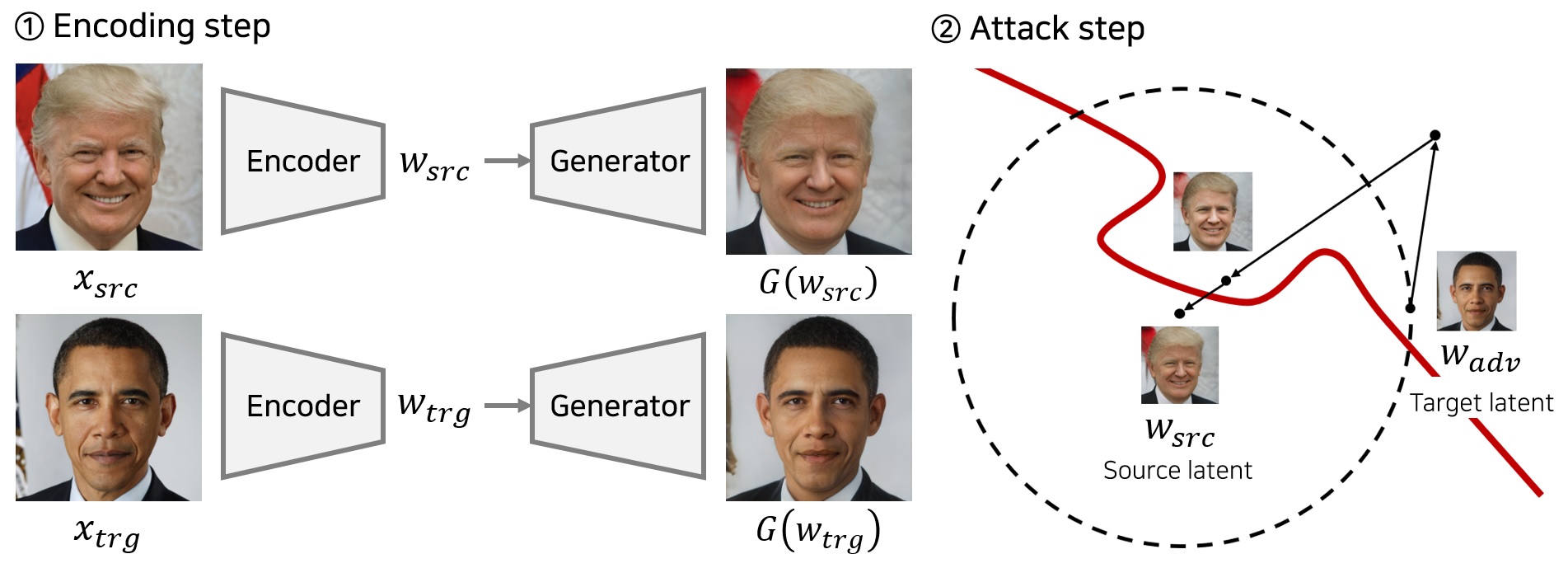
Unrestricted Black-box Adversarial Attack Using GAN with Limited Queries
- This repository provides official PyTorch implementations for Latent-HSJA.
- This work is presented at ECCV 2022 Workshop on Adversarial Robustness in the Real World.
Authors
- Dongbin Na, Sangwoo Ji, Jong Kim
- Pohang University of Science and Technology (POSTECH), Pohang, South Korea
Abstract
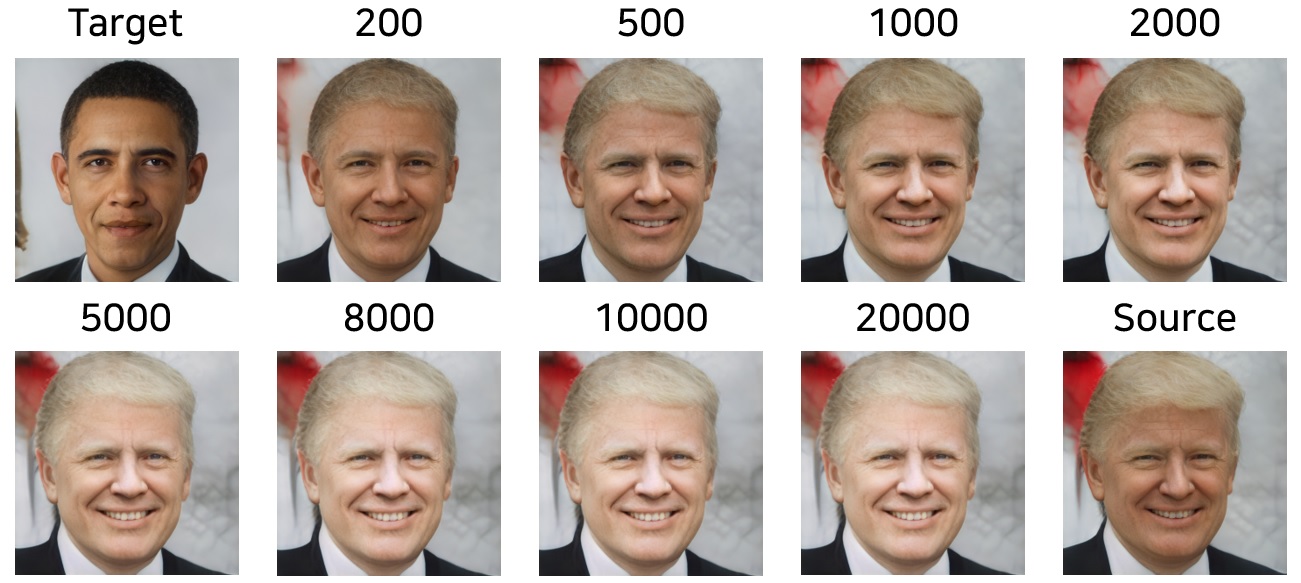
Adversarial examples are inputs intentionally generated for fooling a deep neural network. Recent studies have proposed unrestricted adversarial attacks that are not norm-constrained. However, the previous unrestricted attack methods still have limitations to fool real-world applications in a black-box setting. In this paper, we present a novel method for generating unrestricted adversarial examples using GAN where an attacker can only access the top-1 final decision of a classification model. Our method, Latent-HSJA, efficiently leverages the advantages of a decision-based attack in the latent space and successfully manipulates the latent vectors for fooling the classification model.
Demonstration
Source Codes
Datasets
- All datasets are based on the CelebAMask-HQ dataset.
- The original dataset contains 6,217 identities.
- The original dataset contains 30,000 face images.
1. Celeb-HQ Facial Identity Recognition Dataset
- This dataset is curated for the facial identity classification task.
- There are 307 identities (celebrities).
- Each identity has 15 or more images.
- The dataset contains 5,478 images.
- There are 4,263 train images.
- There are 1,215 test images.
- Dataset download link (527MB)
Dataset/
    train/
        identity 1/
        identity 2/
        ...
    test/
        identity 1/
        identity 2/
        ...
2. Celeb-HQ Face Gender Recognition Dataset
- This dataset is curated for the face gender classification task.
- The dataset contains 30,000 images.
- There are 23,999 train images.
- There are 6,001 test images.
- The whole face images are divided into two classes.
- There are 11,057 male images.
- There are 18,943 female images.
- Dataset download link (2.54GB)
- Dataset (1,000 test images version) download link (97MB)
Dataset/
    train/
        male/
        female/
    test/
        male/
        female/
Classification Models to Attack
- The size of input images is 256 X 256 resolution (normalization 0.5).
| Identity recognition | Gender recognition | |
|---|---|---|
| MNasNet1.0 | 78.35% (code | download) | 98.38% (code | download) |
| DenseNet121 | 86.42% (code | download) | 98.15% (code | download) |
| ResNet18 | 87.82% (code | download) | 98.55% (code | download) |
| ResNet101 | 87.98% (code | download) | 98.05% (code | download) |
Generate Datasets for Experiments with Encoding Networks
- For this work, we utilize the pixel2style2pixel (pSp) encoder network.
- E(ꞏ) denotes the pSp encoding method that maps an image into a latent vector.
- G(ꞏ) is the StyleGAN2 model that generates an image given a latent vector.
- F(ꞏ) is a classification model that returns a predicted label.
- We can validate the performance of a encoding method given a dataset that contains (image x, label y) pairs.
- Consistency accuracy denotes the ratio of test images such that F(G(E(x))) = F(x) over all test images.
- Correctly consistency accuracy denotes the ratio of test images such that F(G(E(x))) = F(x) and F(x) = y over all test images.
- We can generate a dataset in which images are correctly consistent.
| SIM | LPIPS | Consistency acc. | Correctly consistency acc. | ||
|---|---|---|---|---|---|
| Identity Recognition | 0.6465 | 0.1504 | 70.78% | 67.00% | (code | dataset) |
| Gender Recognition | 0.6355 | 0.1625 | 98.30% | 96.80% | (code | dataset) |
Training the Original Classification Models
Citation
If this work can be useful for your research, please cite our paper:
@inproceedings{na2022unrestricted,
  title={Unrestricted Black-Box Adversarial Attack Using GAN with Limited Queries},
  author={Na, Dongbin and Ji, Sangwoo and Kim, Jong},
  booktitle={European Conference on Computer Vision},
  pages={467--482},
  year={2022},
  organization={Springer}
}